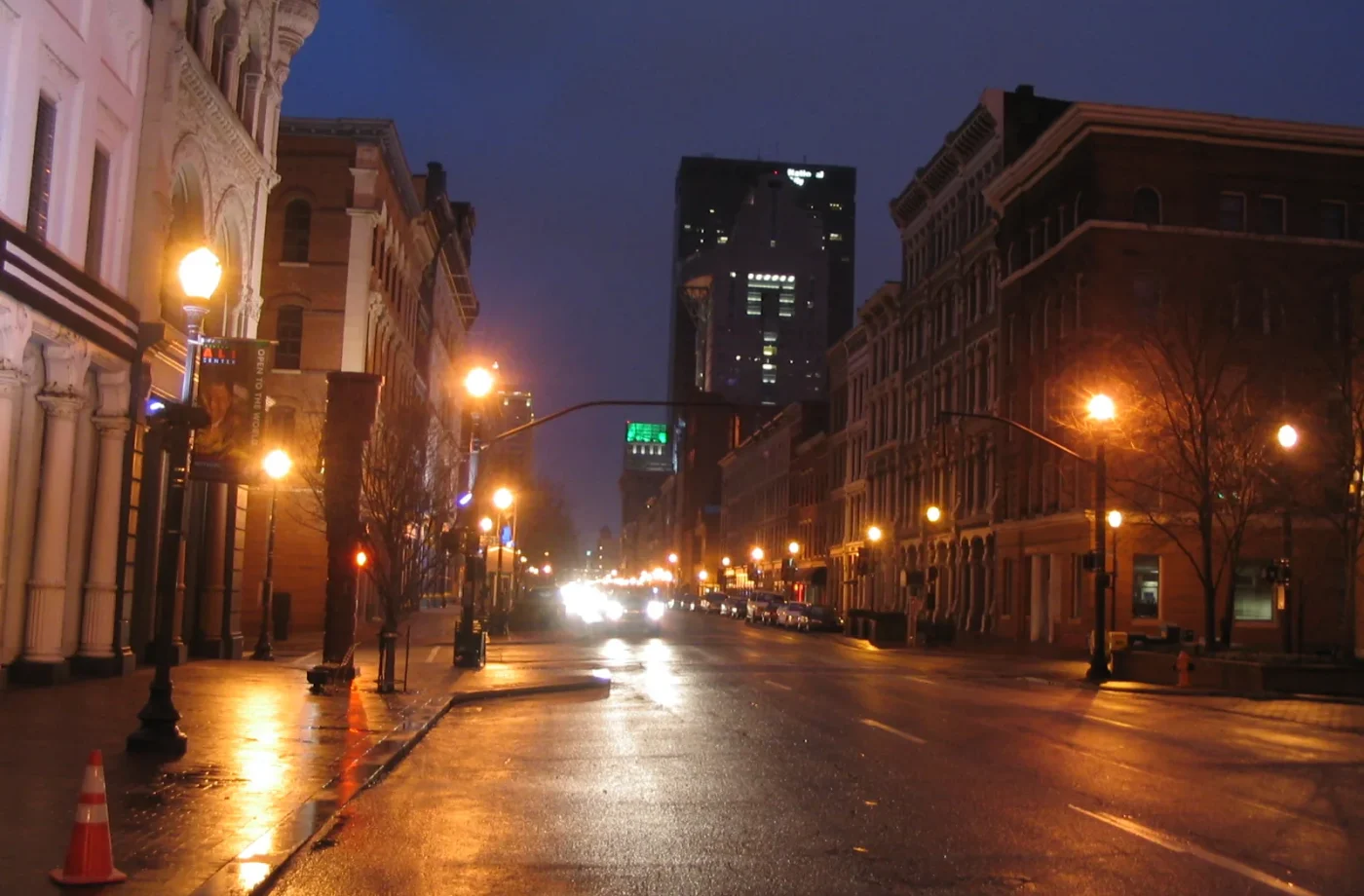
West Main Street is best experienced as a sequence. Rather than moving quickly from one named attraction to the next, slow down and notice how repeated narrow façades create a continuous urban rhythm.
Begin with the verticals
Look for tall windows, slender uprights, storefront divisions, and the way adjoining buildings hold a consistent street edge even when their details differ. Louisville’s preservation materials describe the district as an important concentration of nineteenth-century commercial architecture, including cast-iron façades.
Use a simple observation method
| Look for | What it reveals | How to photograph it |
|---|---|---|
| Façade bays | The lot rhythm and repeated commercial structure | Crop several buildings together |
| Window height | How upper floors differ from the street level | Keep verticals straight |
| Materials | Brick, metal, stone, glass, and later alterations | Move close for texture |
| Storefront edge | How architecture meets daily street life | Include people without treating them as props |
Build context in layers
- First pass: read the whole block.
- Second pass: compare neighboring façades.
- Which details repeat?
- Where does one building break the rhythm?
- Third pass: notice contemporary use, signage, galleries, museums, and entrances.
Respect active places
Main Street is not an open-air set. Keep entrances clear, follow photography rules inside institutions, and avoid blocking narrow sidewalks. Verify current access and opening information directly with any museum, gallery, or business you plan to enter.
When you finish, continue toward the river or shift to a neighborhood street with a different scale. The contrast helps explain why Louisville feels layered rather than uniform.
Still comparing How To Read Louisville’s Cast Iron Main Street?
Ask for tour ideas, hotel suggestions, or a simple trip plan that combines both.